
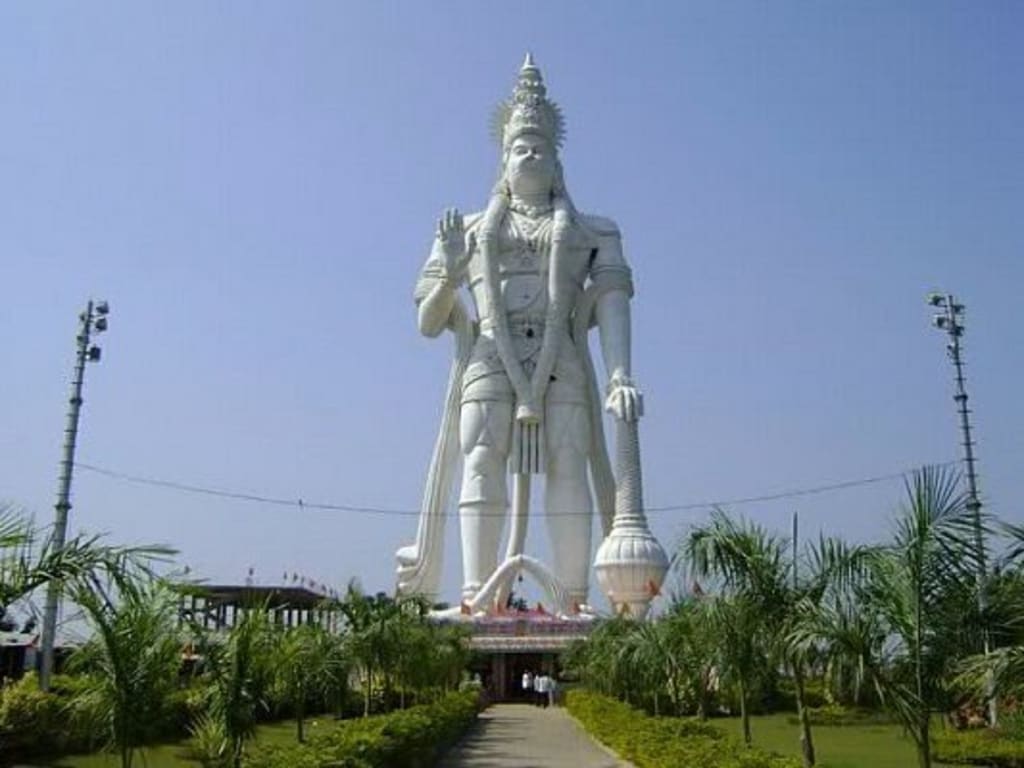

Hanuman is viewed as the ideal combination of shakti and bhakti. Within Hinduism, he is described as a deity, revered as a divine vanara and a devoted companion of Rama.
Tradition holds that Hanuman is the spiritual offspring of the wind god Vayu. According to the Ramayana, he is celebrated for his unwavering devotion to Rama and is considered a chiranjivi, one who lives forever.
His tales are recounted in the Ramayana, the Mahabharata and various Puranas. Hanuman is traditionally celebrated as a lifelong celibate, embodying the virtues of chastity. He is also described as extraordinarily strong, one capable of lifting and carrying any burden for a cause, and he is called Vira, Mahavira, Mahabala and other names signifying this attribute.
What his names mean
Hanuman is known by many names. He is called Bajrang Bali because his body is like a vajra, and the name widely used in rural North India means the strong one who had limbs as hard or as tough as vajra. According to Hindu mythological stories, Hanuman is Maruti, that is Marut-nandan, the son of Vayu.
Hanuman's godfather was Vayu, and for this reason he is also known as Pavan-putra. Other names include Anjaneya, Anjaniputra, Anjaneyar, Anjaneyudu, Anjanisuta, Kesari Nandana, Kesarisuta, Vayuputra, Sankata Mochana, Kapeeshwara, Rama Doota, Mahakaya, Vanarkulathin Thondaiman, Panchavaktra and Mukhya Prana Devaru.
- Bajrang Bali
- Maruti
- Anjani Sut
- Pawanputra
- Sankatmochan
- Kesarinandan
- Mahavir
- Kapeesh
- Shankar Suvan
Linguistic variations of the name also exist across languages: Hanumat, Anuman in Tamil, Hanumantha in Kannada and Hanumanthudu in Telugu.
Different traditions, different origins
In Shaiva tradition, Hanuman is regarded as an incarnation of Shiva. In most Vaishnava traditions, Hanuman is the son and incarnation of Vayu. The Shiva Purana mentions Hanuman as an avatar of Shiva, while all other Puranas and scriptures mention him as the spiritual son of Vayu, an incarnation of Vayu, or sometimes an avatar of Rudra.
According to Hindu folklore as narrated in the Itihasa-Purana, Hanuman was born to mother Anjana and father Kesari. He is the eldest and first of the six sons of the vanara king Kesari and his wife Anjana, according to the Ramayana. In the Valmiki Ramayana, Anjana Devi receives a divine blessing from Vayu, who approaches her through a non-physical agency and grants her a son, Hanuman.
How his worship grew
Devotional practices centred on Hanuman were not prominent in early texts or early archaeological evidence. His theological significance and devoted following emerged roughly a millennium after the Ramayana was composed, during the second millennium CE. Hanuman became more important in the medieval period and came to be portrayed as the ideal devotee of Rama.
Hanuman's life, devotion and strength inspired wrestlers in India. He is also stated to be a gifted grammarian, meditating yogi and diligent scholar, and has been the patron god of martial arts.
Temples and Tuesday-Saturday worship
Tuesday and Saturday of every week are particularly popular days at Hanuman temples, and some Hindus keep a partial or full fast on either of those two days. In India, temple images of Hanuman are commonly coated in a red or orange sindhur mixed with oil.
Among major sites, Hanumangarhi in Ayodhya is a 10th-century temple dedicated to Hanuman. Jakhu temple in Shimla, Himachal Pradesh contains a monumental 108-foot statue of Hanuman and is the highest point in Shimla. The tallest Hanuman statue is the Veera Abhaya Anjaneya Swami, standing 135 feet tall at Paritala, 32 km from Vijayawada in Andhra Pradesh, installed in 2003. Chitrakoot in Madhya Pradesh features the Hanuman Dhara temple, which has a panchmukhi statue of Hanuman.
The 16th-century Indian poet Tulsidas wrote the Hanuman Chalisa, a devotional song dedicated to Hanuman. The Hanuman Chalisa describes him as golden in colour, wearing beautiful clothes and earrings, and having thick, curly hair, with a mace and flag in his hands. The same text describes him as handsome with a complexion of molten gold.
Hanuman is five-faced, or Panchamukha, when he assumes his fierce form. These are the east-facing Anjaneya face, the south-facing Narasimha face, the west-facing Garuda face, the north-facing Varaha face and the horse face Hayagriva facing towards the sky.
For a reader in an Indian metro city, the most visible connection to Hanuman is often the local temple on a Tuesday or Saturday, or the recitation of the Hanuman Chalisa. The deity remains present in daily worship, in neighbourhood shrines and in larger pilgrimage sites across the country.
Hanuman is also described as a chiranjivi, or immortal, in various versions of the Ramayana and Rama Katha. He is the doorkeeper and protector of the door to Rama's court, and protector and saviour of devotees of Shri Ram and himself.