
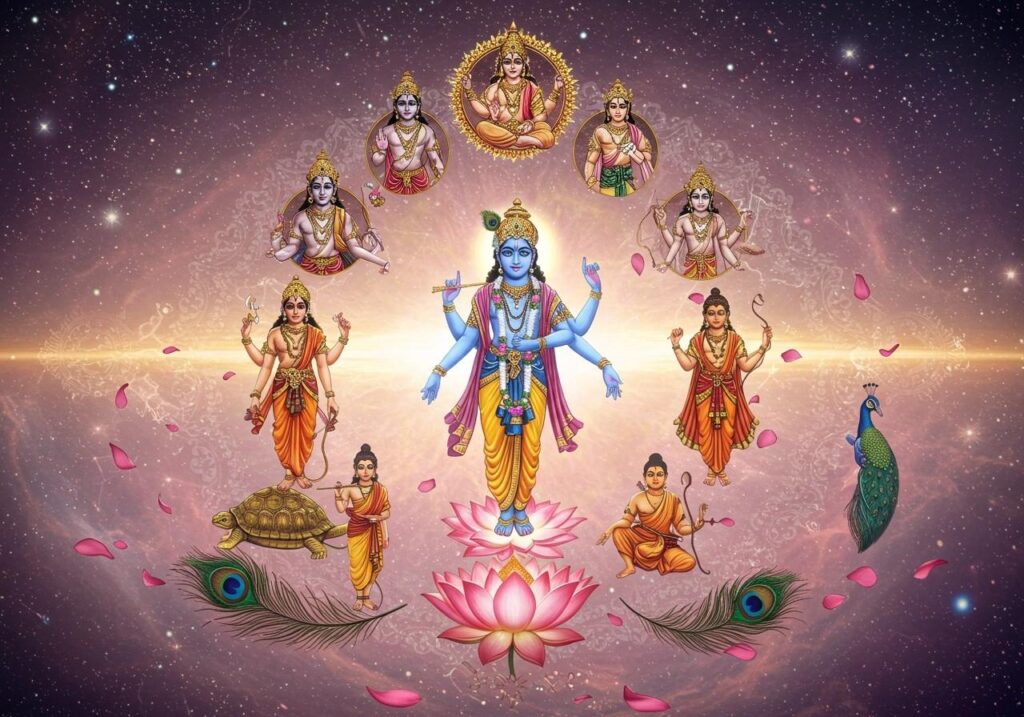

The Dashavatara refers to the ten primary avatars of Vishnu, a principal Hindu god. According to the tradition, Vishnu is said to descend in the form of an avatar to restore cosmic order.
The word Dashavatara comes from daśa, meaning ten, and avatāra, roughly equivalent to incarnation. According to the Bhagavad Gita, when human beings are lost in injustice and unrighteousness, Lord Vishnu takes an avatar to guide them to the right path.
The standard list of ten avatars
According to the Puranas and other texts, the most accepted Dashavatara list is Krishna, Buddha. Most lists draw from a set of figures in the order Matsya, Kurma, Varaha, Narasimha, Vamana, Parashurama, Rama, Krishna or Balarama, Buddha or Krishna, and Kalki.
- Matsya, the fish
- Kurma, the tortoise
- Varaha, the boar
- Narasimha, the man-lion
- Vamana, the dwarf
- Parashurama, the warrior sage
- Rama, the king of Ayodhya
- Krishna, the charioteer of Arjuna
- Buddha, the founder of Buddhism
- Kalki, the final incarnation yet to appear
According to the Dashavatara tradition, all avatars have appeared except one: Kalki, who will appear at the end of the Kali Yuga.
Not one fixed list
The list of included avatars varies across sects and regions, particularly with respect to the inclusion of Balarama or the Buddha. According to the Paripatal, a c. 3rd-4th CE Sangam literature anthology, and the Yatindramatadipika, Balarama is the eighth avatar and Krishna is the ninth avatar. The Balarama and Krishna list version is followed by some Vaishnavas who do not accept the Buddha as an incarnation of Vishnu.
Some traditions include a regional deity such as Vithoba or Jagannath in the penultimate position, replacing Krishna or Buddha. In Maharashtra and Goa, Vithoba's image replaces Buddha as the ninth avatar of Vishnu in some temple sculptures and Hindu astrological almanacs. In certain Odia literary creations from Odisha, Jagannath has been treated as the Ninth avatar, by substituting Buddha.
In traditions that omit Krishna, he often replaces Vishnu as the source of all avatars. Despite these lists, the commonly accepted number of ten avatars for Vishnu was fixed well before the 10th century CE.
A modern interpretation
According to tradition, some modern interpreters interpret Vishnu's ten main avatars as an ascending order from simple life-forms to more complex life-forms. The evolutionary interpretation was first propounded by the Gaudiya Vaishnava saint Bhaktivinoda Thakur in his 1873 book Datta-kaustubha and again in his 1880 book Kṛṣṇa-saṁhita. J. B. S. Haldane suggested that Dashavatara gave a rough idea of vertebrate evolution: a fish, a tortoise, a boar, a man-lion, a dwarf and then four men.
Prakashanand states that this apologeticism degrades the divine status of Rama and Krishna. According to Prakashanand, Rama and Krishna are supremely divine, each right and perfect for the circumstances they appeared in.
The tenth avatar is still to come
According to the Kalki tradition, he is the final incarnation of Vishnu, who appears at the end of each Kali Yuga. According to tradition, Kalki will be atop a white horse and his sword will be drawn, blazing like a comet. According to tradition, he appears when only chaos, evil and persecution prevails, dharma has vanished, and he ends the Kali Yuga to restart the Satya Yuga and another cycle of existence.
Which specific text is the authoritative source for the order of the Dashavatara remains an open question, since sources disagree on the inclusion of Balarama and Buddha. According to tradition, generally the above list of the Dashavatara is accepted, but there are some differences in various scriptures.
